










Peptides have become a fixture in anti-aging skincare, but the word itself doesn’t tell you much. One formula may use them to support firmer-looking skin. Another might focus on hydration or the appearance of fine lines. The specific peptide and the rest of the formula make all the difference.
Peptide skincare can address early signs of aging without a lot of extra effort. It also works well for guys who want more from their moisturizer or serum but aren’t interested in chasing every new ingredient trend.
What Are Peptides In Skincare?
Peptides are short chains of amino acids, the same basic components your body uses to make proteins. Collagen and elastin are two such proteins, and both help give skin its structure and flexibility.
In the skin, certain peptides also behave like messengers. They help repair, hydrate, and offer structural support. Cosmetic peptides are developed to imitate or complement some of those signals when applied topically.
Tetrapeptides contain four amino acids, while hexapeptides contain six. Prefixes such as “palmitoyl” indicate that the peptide has been modified with a fatty-acid component. This can influence how the ingredient behaves in a skincare formula.
None of that means every peptide does the same job. Their effects depend on their amino acid sequence, concentration, delivery system, and supporting ingredients. A product containing peptides is not automatically effective simply because the word appears on the front of the bottle.
Benefits Of Peptides In Skincare
Well-formulated peptide products can help improve the visible firmness, smoothness, and overall condition of the skin. Some peptides are used to support the moisture barrier. Others are included in products that target fine lines or a gradual loss of elasticity.
They also tend to fit comfortably into an established routine. Many peptide ingredients are less aggressive than strong exfoliating acids or Vitamin A treatments when considered on their own. This can make them appealing to men whose skin is already dealing with shaving, dry weather, or the occasional overenthusiastic scrub.
Still, peptides aren’t instant face-lifts. Clinical evidence varies considerably between individual peptides, and the finished formula matters more than a single ingredient. Research shows encouraging results for certain topical peptides, though many cosmetic peptides have limited independent clinical data.
Collagen Peptides & Anti-Aging
The phrase “collagen peptides” can be confusing. It sometimes refers to hydrolyzed collagen used in supplements. In topical skincare, it may instead describe peptides intended to interact with processes associated with collagen support.
Think of them as messengers rather than miniature pieces of replacement collagen. Certain signal peptides are designed to imitate fragments that appear when collagen naturally breaks down. The idea is to encourage a response associated with repair and renewed structural support. That may help the skin look firmer or make fine lines appear less pronounced over time.
A peptide product cannot erase years of sun exposure, and it doesn’t replace sunscreen. UV damage is one of the largest contributors to premature collagen breakdown. Peptides make more sense as part of a broader anti-aging routine: protect the collagen you have, then use targeted products to improve how the skin looks and feels.
How To Incorporate Peptides In Your Skincare Routine
A dedicated serum typically goes on after cleansing and before moisturizer. This gives the lightweight formula direct contact with clean skin. Follow the amount recommended on the product rather than covering your face in half the bottle. More product doesn’t necessarily produce a faster result.
Peptides can generally be used in the morning, evening, or both. Pay attention to the complete formula, though. A peptide serum that also contains glycolic acid needs to be treated differently from a simple moisturizing peptide cream. Anyone new to exfoliating acids may want to introduce that type of product gradually and watch for persistent dryness or stinging.
There’s no universal rule that peptides and acids must always be separated. Formulators can create products that contain both, as we do with our Glycolic Peptide Serum. A finished product has been developed as a whole. Randomly layering several powerful formulas is where a routine can become harder to tolerate.
Vitamin A products deserve similar care. Introduce one new treatment at a time. If using a Vitamin A treatment and an exfoliating peptide serum causes irritation, alternate them between different evenings instead of forcing both into the same routine.
During the day, finish with broad-spectrum sun protection. That step protects the results you’re working toward and helps limit additional damage from UV exposure.
The Best Skin Care Products With Peptides For Men
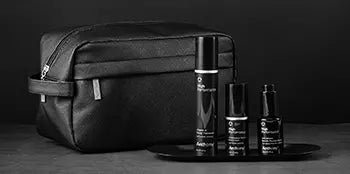
At Anthony, we use several different peptides across our High Performance collection. Each product has a distinct place in the routine, from an all-over facial serum to targeted care for the eye area.
High Performance Anti-Wrinkle Glycolic Peptide Serum
Our High Performance Anti-Wrinkle Glycolic Peptide Serum is the most direct option for introducing peptides into a men’s skincare routine. It combines three peptide ingredients: Palmitoyl Hexapeptide-19, Palmitoyl Tetrapeptide-7, and Palmitoyl Hexapeptide-12.
That trio is paired with glycolic acid, giving the serum a two-part approach to visible aging. Glycolic acid exfoliates the skin’s surface to help improve dullness, uneven texture, and fine lines. The peptide blend supports the formula’s firming and smoothing goals.
Pullulan adds an immediate tightening feel, while glycerin helps attract moisture. Algae extract and biotin round out a formula designed for skin that looks tired, less firm, or rougher than it used to.
Apply a few drops to a clean face and neck, avoiding the eye area. It can be used in the morning or evening before moisturizer. Because the formula contains glycolic acid, daily sun protection is essential. Men with sensitive skin can begin with less frequent applications and increase use as their skin adjusts.
High Performance Continuous Moisture Eye Cream
The skin around the eyes is thin, expressive, and often the first place fatigue appears. An all-over facial treatment isn’t always appropriate there, especially one containing glycolic acid.
Anthony’s High Performance Continuous Moisture Eye Cream gives that area a more targeted option. Its formula contains Palmitoyl Hexapeptide-12 and Palmitoyl Tetrapeptide-7, two of the peptides also found in the Glycolic Peptide Serum.
Here, however, they sit within a richer moisturizing base. Sodium hyaluronate helps hold water near the skin, while shea butter and squalane soften the eye area. Caffeine and arnica address the appearance of puffiness and dark circles. The result is a formula aimed at several common eye-area concerns without relying on one ingredient to do everything.
Dispense one or two pumps onto a ring or index finger, then gently tap the cream beneath the eyes and around the brow bone. There’s no need to rub or pull at the skin.
High Performance Vitamin A Facial Treatment
Men with normal-to-dry skin may prefer a treatment that combines peptide care with deeper moisture. Our High Performance Vitamin A Facial Treatment contains Acetyl Tetrapeptide-9 alongside a Vitamin A derivative, shea butter, and squalane.
Acetyl Tetrapeptide-9 is used as a skin-conditioning peptide in anti-aging formulas. In this treatment, it supports a broader approach to firmness and fine lines.
Apply a dime-sized amount over a clean, dry face and neck. The product can be used in the morning or evening, although men with reactive skin may find nighttime use easier to manage. Follow with an SPF Day Cream whenever it’s worn during the day.
Want to learn even more about peptides in men’s skincare? If so, be sure to check out the great products and solutions available at Anthony today!